Through intention, serendipity, and a dedicated commitment to ceramics education, Keaton Wynn, in collaboration with some equally committed educators in China, created a remarkable educational experiment in Lanzhou, China that began at Georgia Southwestern University in 2012.
 What started as a three-year research grant in 2013 transformed into building a new ceramics studio at Lanzhou City University, establishing the only degree-granting ceramics program in a province of almost 26 million people and creating a faculty exchange and artist-in-residency program. Keaton and his Chinese collaborators made this while maneuvering a labyrinth of government and university bureaucracies and teaching full-time at Georgia Southwestern State University.
This remarkable story begins in 2012 when Georgia Southwestern State University hosted Wang Jianjiang as a visiting scholar from Northwest Normal University in Lanzhou. During that year, Keaton and Jianjiang worked on a project to address Jianjiang's interests in contemporary cultural issues in Western China while drawing upon the area's ancient historical importance, which is defined as Dunhuang Culture. Dunhuang was the gateway to the Silk Road, the initial migration point of Buddhism to China, and near the center of the Majiayao Neolithic ceramics tradition.
Lanzhou is the capital and the largest city, with 3.8 million people, in Gansu Province, alongside the Yellow River. This area of Northwestern China was an integral part of the Silk Road's history and what is known as Dunhuang Culture. Dunhuang is known for Buddhist sanctuaries and frescos.
The Chinese government awarded Keaton and Professor Wang a three-year grant through Northwest Normal University in Lanzhou to develop a research center to produce contemporary artworks that responded to Dunhuang Culture. This was an experimental project to develop works that honor the past.
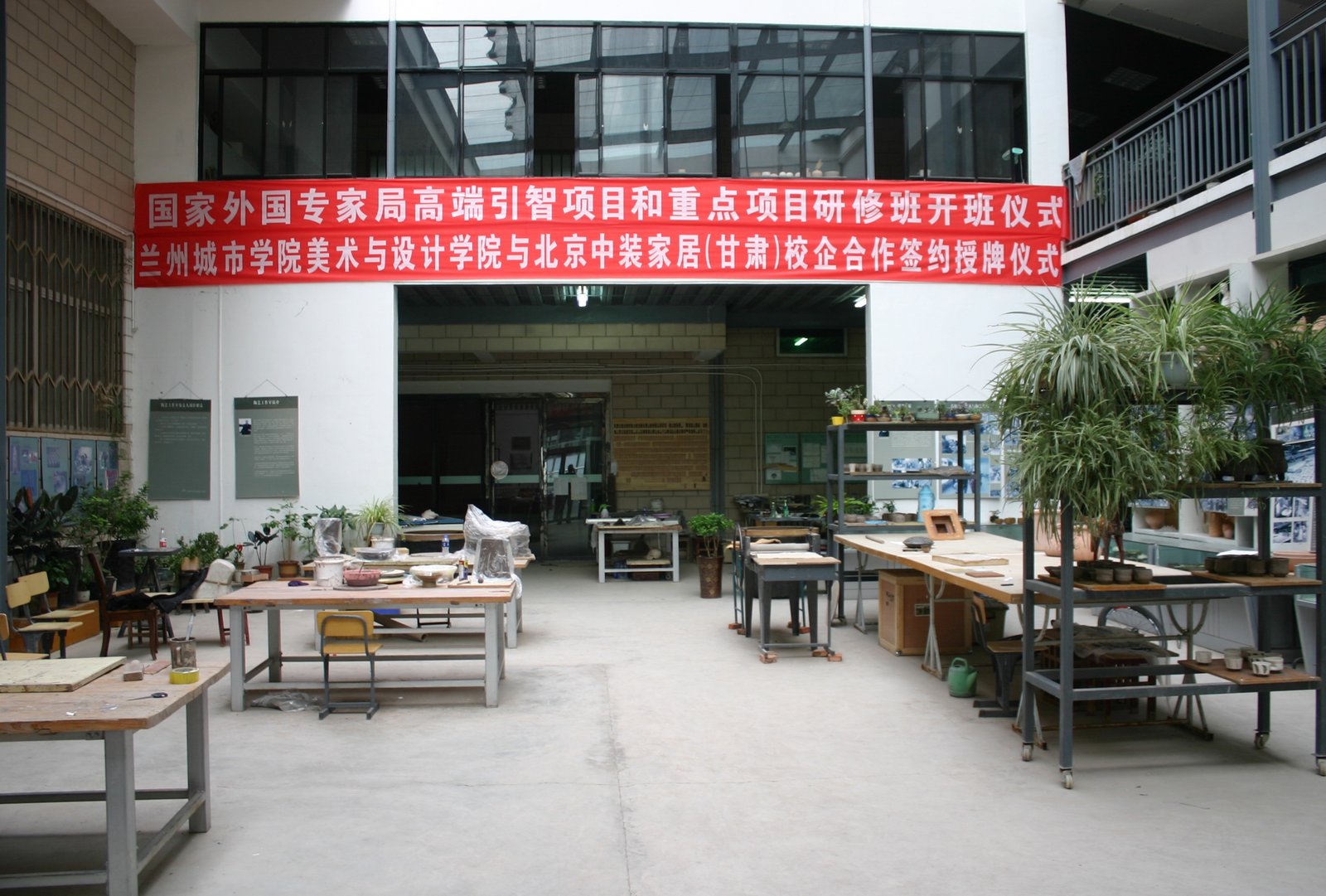
During the start-up phase, Professor Wang left his position at Northwest Normal University and took a job at Southwest Shanghai Normal University in Shanghai. The project was moved to Lanzhou City University which launched a new collaboration with the head of the College of Art, Dean Zuo. This experimental program took physical form with Dean Zuo's support and guidance. In the summer of 2013, program participants built a ceramics studio and surveyed and tested local clay and glaze materials. Keaton wanted to use local ceramics materials as much as possible. During that first summer, while the studio was being completed, Keaton taught Contemporary Western Art History and an Art Installation course.