

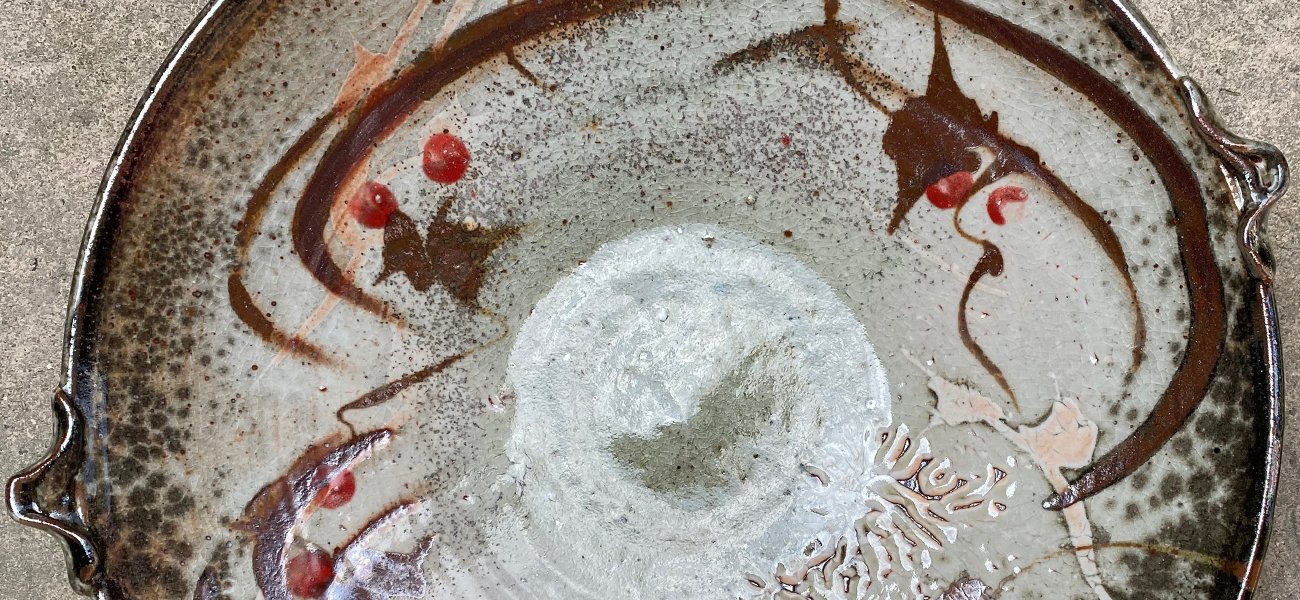
Embracing the Squish – An Interview with Tony Clennell
Editorial note: This is the sixth and final interview in the "Embracing the Squish" series by Hamish Jackson for Studio Potter. In this series, Hamish speaks with ceramic artists whose pots seem to defy the finality of the firing process – works that hold onto the softness, the movement, and the vulnerability of wet clay. These are pots that remember the hand, the squeeze, the gesture.
Hamish's conversations explore how these artists use clay’s most tactile qualities to express feeling, form, and meaning. From pinched mugs to slumped jars, these pots carry a sense of immediacy, even playfulness – a kind of looseness that invites both curiosity and comfort.
There is much to learn from potters who embrace the squish. Their work reminds us that the process is not just about control and refinement but also about letting clay be clay. – Randi O'Brien, editor
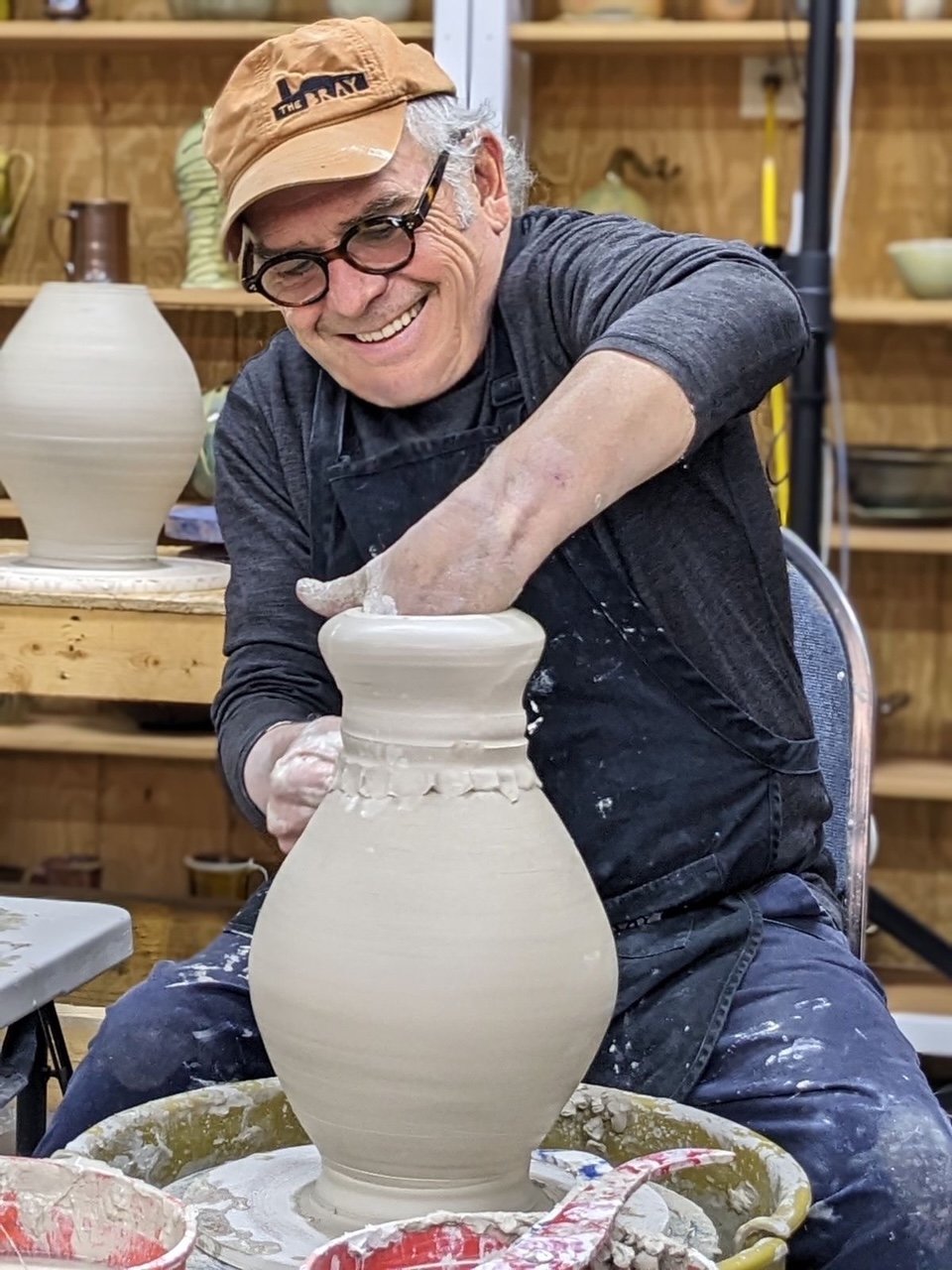 Recorded on April 21, 2025.
In this interview, Tony reflects on his time at Utah State University (USU) under the tutelage of John Neely. We recorded it before John’s passing. We dedicate this interview to John and thank him for all he gave to us and his many students.
Hamish
Thanks for joining me.
Tony
My pleasure. I'm thrilled.
Hamish
I should give you a little intro on what this project is about. I am talking to some of my favorite artists whose finished pots retain some of the softness of the clay; you can see the squishiness in them still. This is something I'm trying to do more in my potting. I am interested in how you came to make more expressive pots. I've got one of your mugs here. It's really good. The handle is particularly expressive. To begin with, though, when did you first touch clay?
Tony
I started making pots when the mountains were cooling. At six years old.
My aunt and uncle were studio potters here in Ontario. I still work at their pottery teaching. It's now 80 years old. My Uncle Jim was English and was my first teacher. I made pots for the tourist trade for 25 years. They were perfect pots. They didn't have those undulating rims or squishies or anything like that.
Hamish
What changed?
Tony
Two of the people that you're interviewing have been a huge influence on my career. The first was Linda Christianson. Linda and I go back over forty years. She came up to Ontario to help me build a two-chamber wood kiln. We would build the kiln during the day, and at night, we would make and talk about pots. It's really Linda that I owe a great debt to in terms of my handles. She was the one who started me making handles.
Then, I was teaching at Sheridan College School of Craft and Design with Bruce Cochrane. Ron Myers came and did a workshop. Ron and I got along like best buddies. That was in the year 2000? For twenty-five years, I've always gone to Ron's every year and fired his wood kiln. He would visit my pottery, and I would visit his pottery. When you have friends who make expressive pots, you don't want to invite them in and show them tight pots. You want to show them your best. So Ron and Linda were and are a huge influence on me.
People tell me I’m a casual maker, but I'm not. I'm actually a pretty tight maker. I make them tight, and then I squish them. I remember inviting Ron to come and participate in a workshop I was teaching in Atlanta, Georgia. I would make a plate on a bat and then pinch it, make marks and all that stuff, thinking I was a casual maker. Ron would make a plate and pick it up, and throw it on the table, and the rim would go like this. But it really worked. They changed my whole view. I mean, when you first start making pottery, you think you should aim for thin and light. You think that is good pottery, but no, it looks like it's good pottery, but it's not good pottery.
Hamish
It can be!
Tony
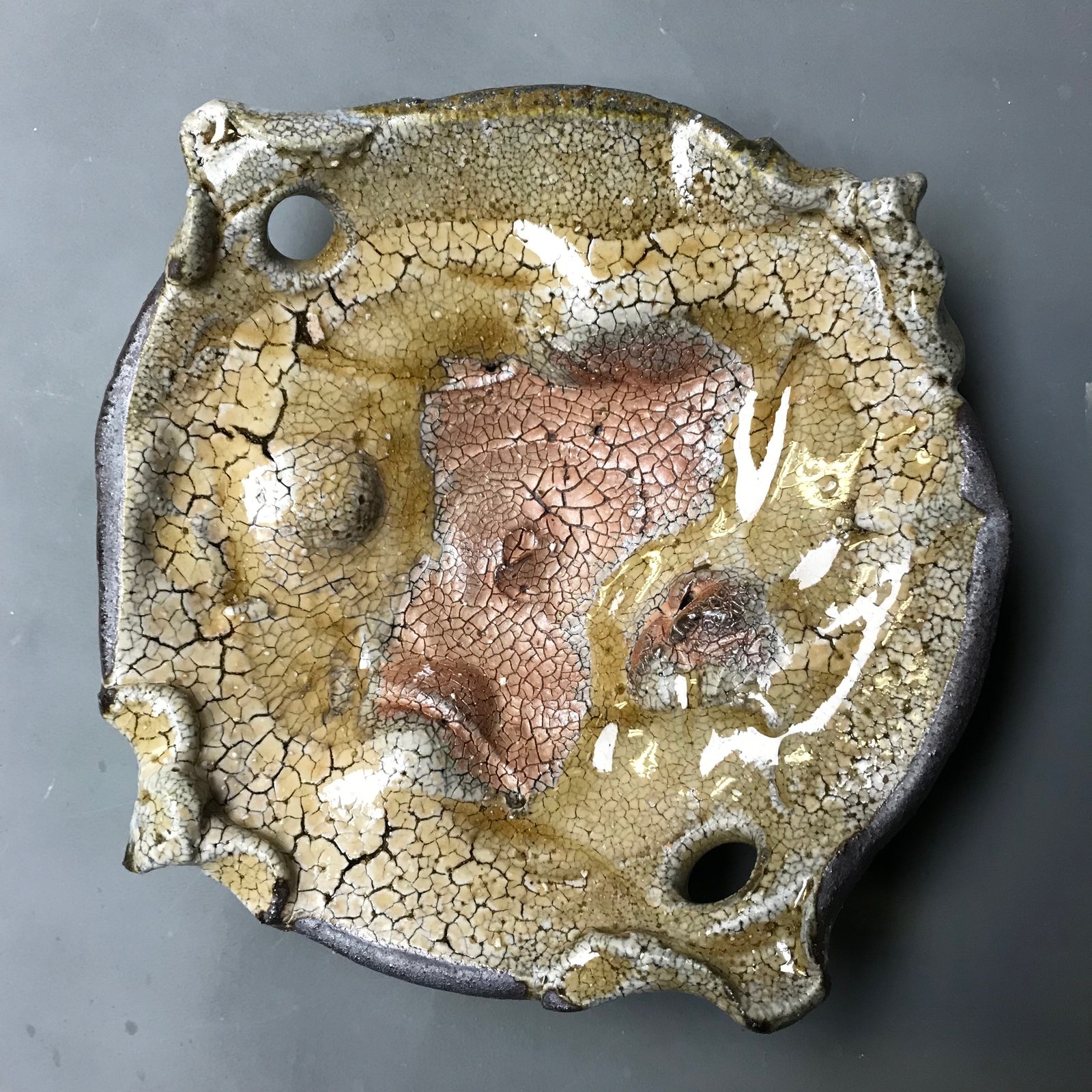
Yeah, you're right, you're right. It can be. But I prefer pots that could be loved by a blind person. It's really more about tactility for me than that beautiful copper red glaze or whatever. For me, it's more about feel.
Hamish
I think a lot about tactility too. When I'm squishing, I want them to be soft, but sometimes the edges and little pieces of clay can come out quite sharp. It's okay, I think, but a blind person might not find that as appealing.
Tony
For me, those bits are the art. That's an important little piece I want. I don't want to take that off. I know I should have for the marketplace, because I know people look at that and think he didn't clean that up too well.
Hamish
Do you think about softening edges and sharp bits?
 Tony
Tony
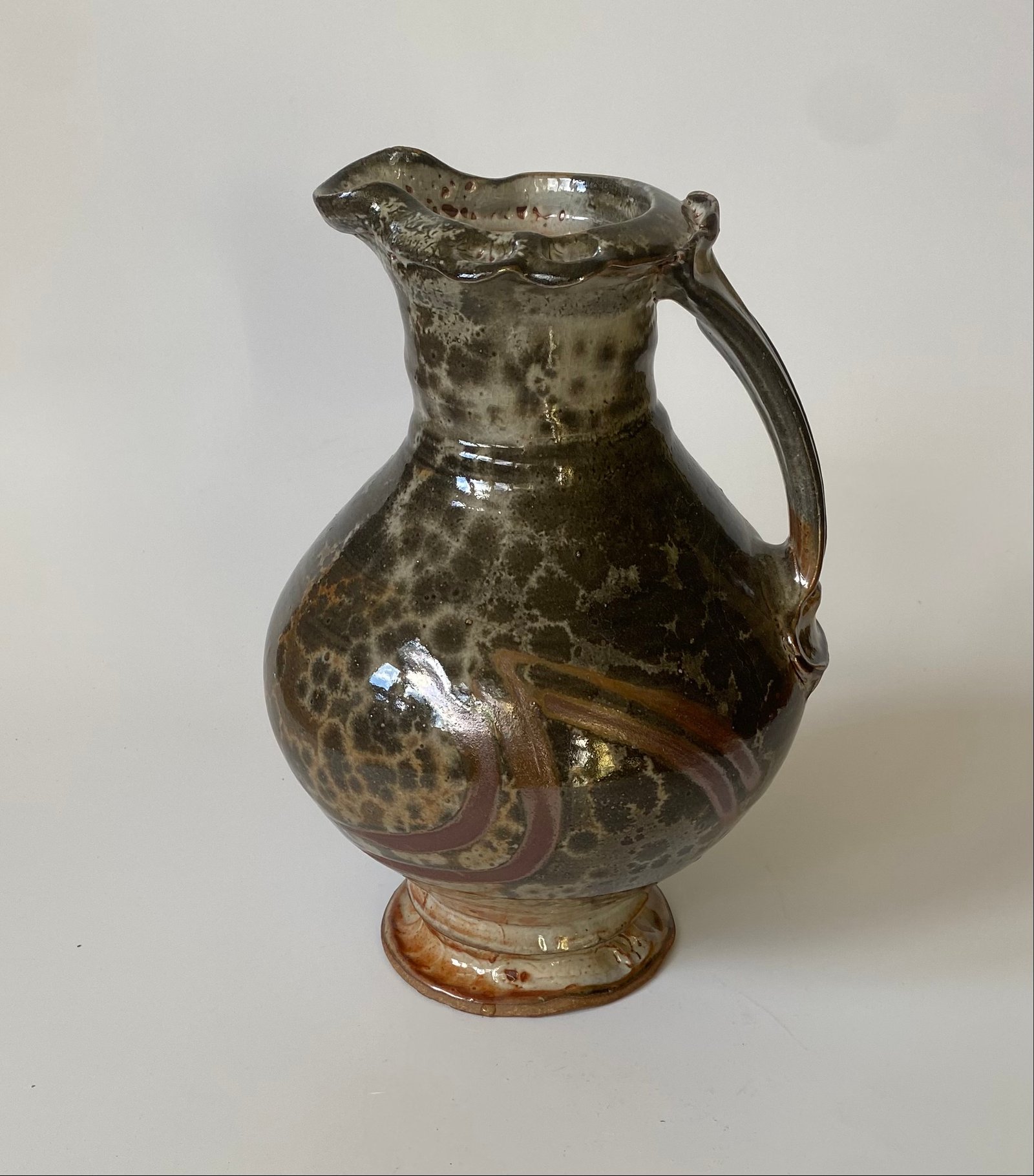
I hope I do. Sometimes I like the sharp edge, though. The softness has to do with the play. It is a soft material, and I don't think we should be treating it like wood or metal. We don’t turn like we are working on a lathe. One of the really important things that I learned from Linda way back forty-five years ago was, first of all, the number one ingredient of squishy casual pots is the clay.
If you take clay right out of the bag from the clay supplier, it's not good for squishy pots. It has some sort of plastic memory that I don't like. I found that the best pots I ever made are from reclaim. My clay supplier here in Canada, Frank Tucker, said to me, Tony, I have a million-dollar pugmill, and you take my clay, and you throw it in your crappy old pugmill. Why are you doing that? I said, Frank, there's a whole bunch of reasons. One, it softens it. Two, it gets rid of that memory. Three, I make better pots with it.
Hamish
Do you add a bit of extra water to it when you're pugging it?
Tony
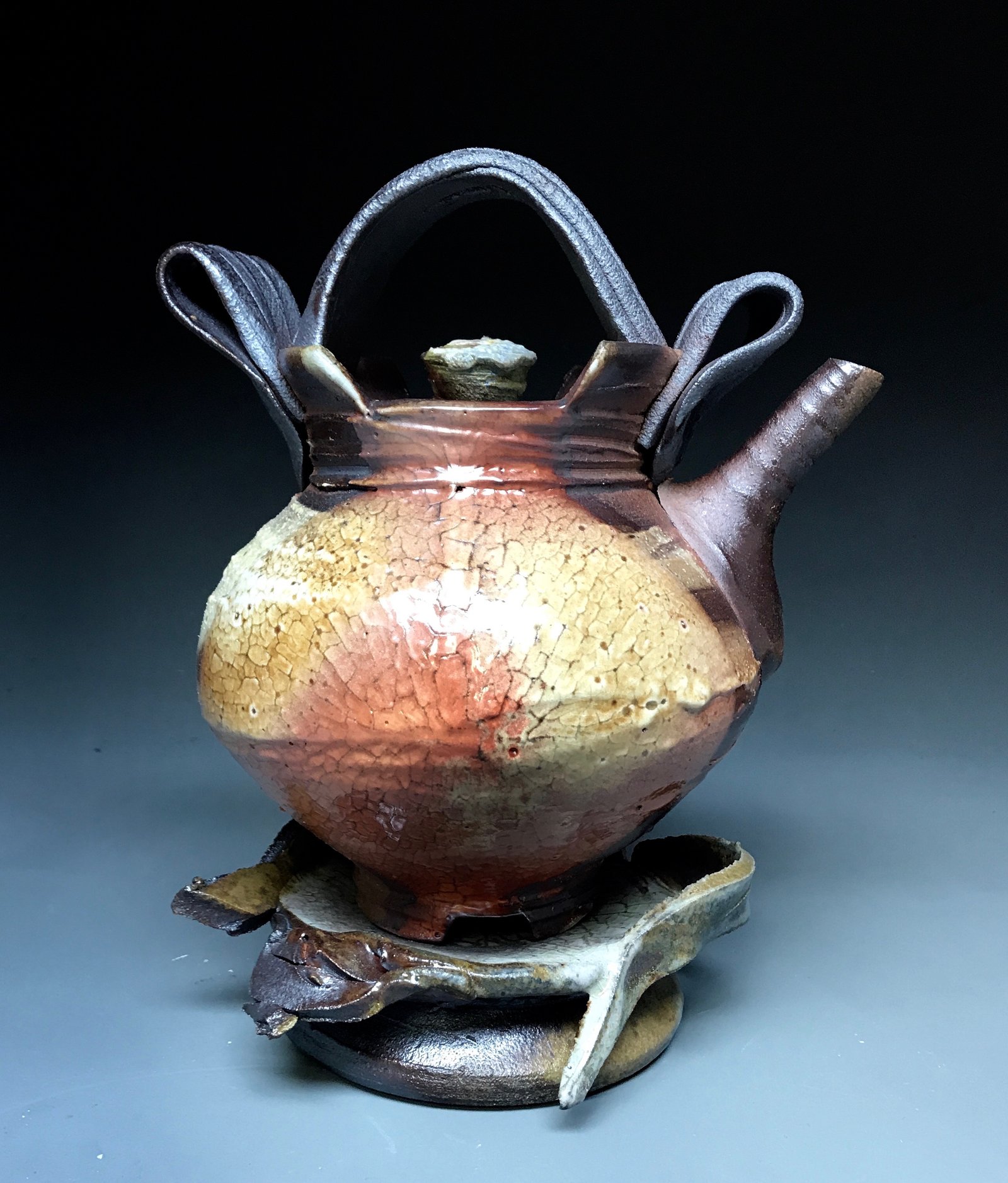
I don't, but usually there's some reclaim or something that goes in there too. Sometimes I put in wet silica sand, which gives it a little bit of tooth and trims nicely. It trims beautifully. And really, the trimming process is the most important thing for me. It's not the throwing, but the trimming, where I can put most expression into the pots. You have to trim at a sort of soft cheese stage, not leather hard. Leather hard, and it is going to be tight.
John Neely says it better than anybody: Ceramics is the art of timing. You have to get the clay at the right time.
Hamish
Do you ever find you have problems with applying pressure to the base of a bowl, and it's at that soft cheese consistency?
Tony
No, and it's probably because I throw fairly thick. I mean, I'm not a thin thrower. I want a big, thick foot ring.
Hamish
Do you trim most forms?
Tony
Everything. Yeah, it's the process that I enjoy the most. I enjoy trimming, and I enjoy fiddling with them and putting handles on. I shouldn't admit this on camera, but I’m not really crazy about throwing. It's dirty. I'm a gentleman, you know.
Hamish
Yeah, right. You made pretty tight forms for a long time. Do you find it hard to shake that muscle memory? Or do you kind of throw in that way and then alter?
Tony
I like where you're coming at it from. I think you have to learn to be a tight thrower before you can be a casual thrower. I really think you need that foundation of repetitive work. Some people think that they're making casual pots, but they're making bad pots. This is wabi sabi? No, it's not. It's just bad.
Hamish
This is one of the things I’m struggling with when trying to make squishier pots. There's a fine line between bad pots and interesting pots, I think. It's tough.
Tony
It is tough. They're hard to make. Every one of those marks that you make, everything you pause to do, takes time. If you're a student of Isaac Button’s or Harry Davis or whatever, no, they wouldn't stop to do those things. Those are sort of unnecessary marks, right? And time-consuming! I guess I have the luxury now that I don't have my kids to raise or anything. I have the luxury now that I don't have to make as many pots as I used to.
I don't apologize for the tourist pots that I made. I had to. I had a family to raise.
Hamish
Who were some of your formative teachers?
Tony
Mick Casson in Wales, Harry Davis, Roger Kerslake, who is a friend of John Neely’s. John went to school with Roger's wife, Heather, at Alfred. Roger is probably the best unknown teapot maker in Canada. He doesn't get out there and flog his work, but look him up. He was my teacher and very influential on me. If I have the shoulders of giants to stand on, first of all, it would be my uncle, then Linda Christianson, Ron Myers, and John Neely. John was amazing for me. I went to USU for John, but in a funny way, I was probably more influenced by Dan Murphy. But John was very important to me.
Hamish
What rubbed off on you when you went to USU for grad school? You were already making quite expressive pots before, so how did the experience change you?
 Tony
Tony
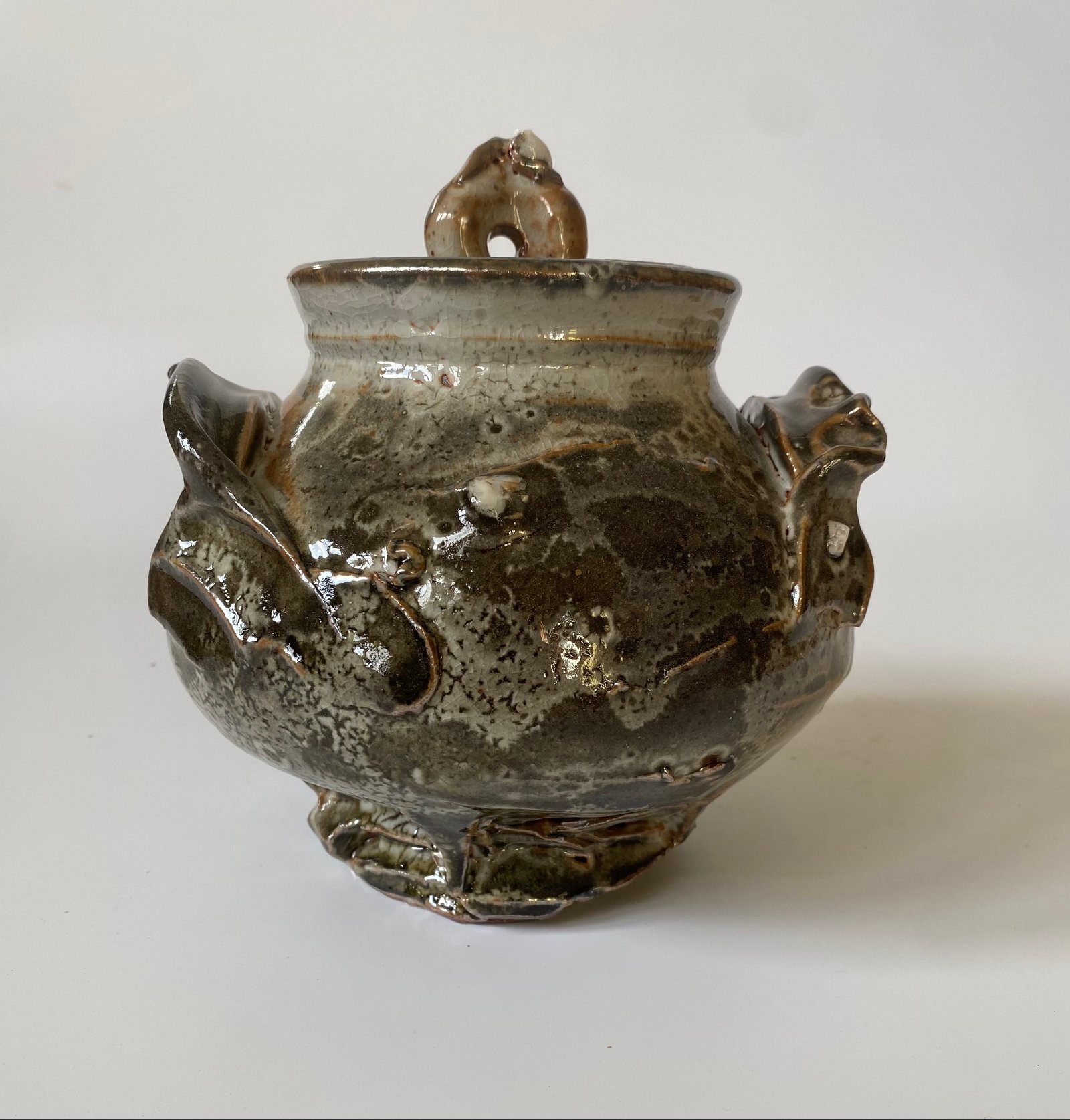
First of all, I got there and threw for the first little while, and John said, No, you're not going to throw anymore. You're going to hand-build. We already know you can throw. So that was a blow. But he was saying, if you want to be a teacher, you've got to know how to do it all. When I was at USU, I had the best group in the world to be with.
Hamish
Who was there then?
Tony
Oh, geez, Lindsay Oesteritter, David Peters, Trevor Dunn, Danny Gerwin, Ernie Gentry, Bobby Free, Sunshine Cobb, Cj Jilek, Mandy Stigant, Perry Haas, Robin Dupont, Joe Singlewalt, Danny Crump, Johnnie Larson, and how could I forget my landlady and great friend Heidi Kreitchnet. God, I'm probably missing some people.
Hamish
That's a great set.
Tony
It was incredible. I was sort of their uncle at fifty-five.
Hamish
What were the critiques like?
Tony
Oh, they were horrible. I mean, I shouldn't say horrible. They were frightening. We had eight or nine graduate students. Todd Hayes and Corey Brown were also undergraduates at that time. You'd have all of these people standing around, and you'd go home at night and think, holy shit, man, I don't know what to do. You'd have nine different voices in your head saying, “This is good, this is not good…” blah, blah, blah, and it was really the first time in my life that I'd ever experienced critiques. Yeah, it was wonderful and frightening.
Hamish
So you hand-built the whole time you were there?
Tony
I did, and in many ways, Hamish, I wish I had stuck to my guns and remained a thrower. I didn't have the courage, I guess. I do both of them now, which is good. I didn't do any hand building before I went to USU.
Hamish
How did your pots shift afterwards? Did it take a little while to sink in?
Tony
I think so. More mark-making happened after USU. Dan Murphy's work with the slip squeezing out of it was incredible. I still go back to that. Dan was right next door to me.
Hamish
He's got such a good touch.
Tony
Oh, I know, such a great mark maker.
Hamish
Was there a tipping point for you in your evolution as a casual potter, or was it a slow process?
 Tony
Tony
Can I just grab a jug and show you?
Hamish
Absolutely!
[Dramatic pause whilst Tony is away]
Tony
I’m back.
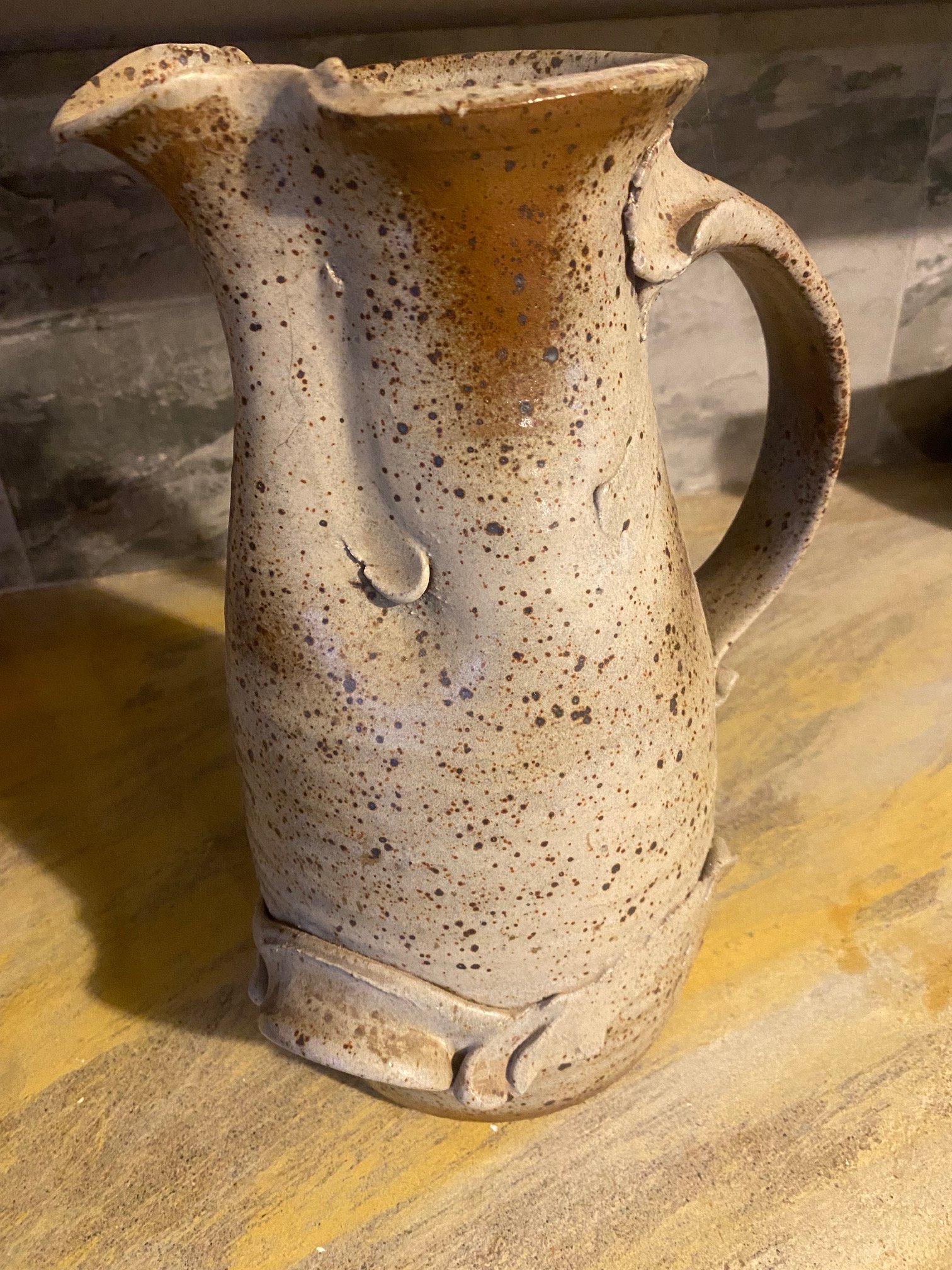
I bought this jug when I was in my twenties. I didn't know why I loved it, but it was the first casual pot I ever bought. I couldn't dare myself to make it. Just look at the handle. It’s just so casual. I thought, wow, does anybody ever buy these?
Hamish
Do you know who made it?
Tony
Yeah, it was made by an Alberta potter called Neil Liske. I don't even know if he makes pots anymore. He's probably a fairly old man, older than me.
Hamish
I like that word, casual. Is that how you see your pots?
Tony
I do. I think the two words I like to use are casual and animated.
I think there should be some animation to pots. I used to hand out a sheet to my students. It had a tombstone with RIP on it. I'd ask them to write two or three adjectives on the tombstone: a description of themselves.
You are your pots. That's who you are; you can't help yourself. And so, a couple of the adjectives that I’d like to add to mine are direct, animated and casual.
Hamish
This is part of the adventure. I’m trying to make parts that are more reflective of my personality. I'm not a very tight person. I'm clumsy and often late. I take on too much as well, but also, hopefully, I'm generous.
Tony
Generous is a great word. A great word for pots and their volume.
Hamish
That's what I would like, more generosity and softness. Animation too. But then, as you say, I think the pots are always inherently yours. When you were making pots for the tourist market, how did you feel about them?
Tony
I am embarrassed to say I probably didn't feel much about them. I was in production throwing. Now I teach a lot of people that they don't need to make a living from pottery. If they're not raising their child, or anything on their pottery making, I say, make whatever you want to make.
You don't need to make these silly little things that are for sale. I did. I had to make them. I made mugs for people with big noses. I've made heart-shaped ashtrays. I've sold pottery in stores called Nancy's, Nibbles, and Knits. I did whatever I had to do to make a living. Now, you know, I get an old age pension. I don't need to make them anymore.
Hamish
This reminds me of a comment you made on one of my posts where you said that making squishy pots is a dark path. It will be harder to make a living. Have you found it harder to sell your more casual pots?
Tony
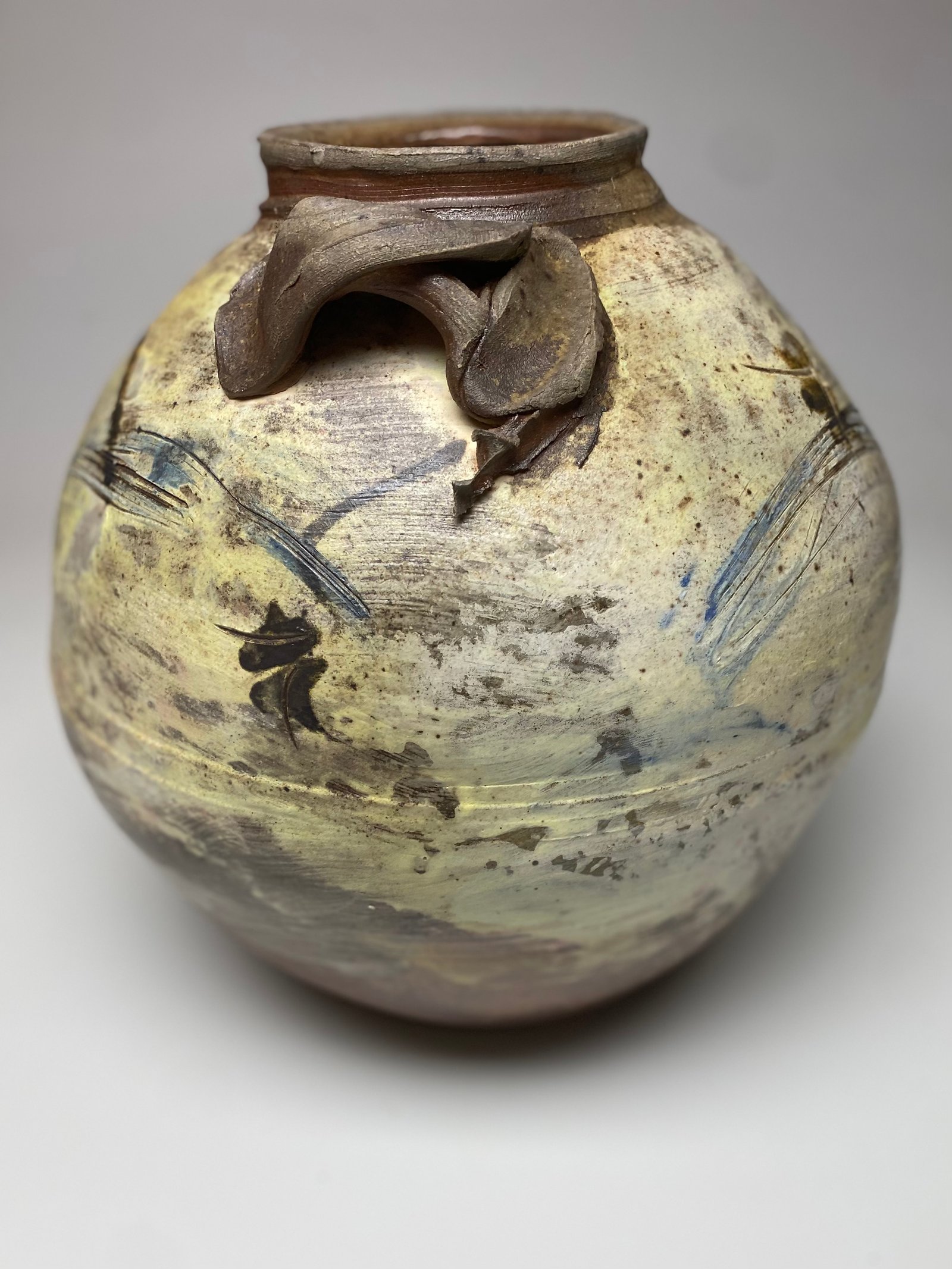
Well, there's a funny market out there right now, Hamish, and it seems like potters are buying potters' pots. Potters buy pottery, and so that's pretty well where my pottery goes. I think the analogy I draw sometimes is that when we’re in our early twenties, we start up drinking beer, and then in our thirties or something, we move on to wine, and then in our forties or fifties, we start on single malts. I think squishy pots are kind of like that. They're the single malts. They're not for everybody. I doubt anybody on my street would want one of my pots. I really don't.
Hamish
I'm not sure. I think there's so much interest in a form that's not perfectly round or straight. There's more to be learned. There's more to be enjoyed over time.
Tony
But you're an educated man. You have an education in clay, and I think that’s huge.
Hamish
Yeah, I suppose most people use cheap industrially made pots.
Tony
One of the biggest compliments I've ever had about my pottery was: “Tony, your pottery doesn't look like pottery.” I like that. A lot of pottery kind of looks like pottery, you know, it's not really very interesting. Oops, I shouldn't have said that. I remember my former wife went on a pot-buying trip to Minnesota, and I said, “Would you please bring me back a Warren MacKenzie tea bowl?”
So she brought one back. It was four bucks or something like that. It was just a little tea bowl. It has a squished thumb mark on the side. I thought, wow, this guy is supposed to be one of the best potters in the world, and this is what I get. But the funny thing is that every time I picked up that cup to have a drink out of it, I would turn it around to see that little squish. And I thought, Warren, you got me again. You keep getting me. As if that mark would disappear. It ain't going to disappear. It's always going to be there. But that little dink, that’s the most important part of the cup for me.
Hamish
Yeah, totally, those are the parts I find myself playing with. I'm biased because I like doing things with my hands, but I feel like there's something important there about the tactility of pots. I'm never just holding a pot; I'm examining it without thinking.
Tony
All potters do that. It’s so interesting. You go, watch potters when they pick up an interesting cup. Their fingers are going all around it and around the foot ring. We're tactile people.
Hamish
At a USU ceramics sale, I put out some seconds, and remember John Neely commenting that the unwashed masses might appreciate them. Do you try to educate the unwashed masses on the value of a squishy or tactile pot?
Tony
No, I gave up on it. Selfishly, I like to talk to people who are interested in my work. I'm kind of not interested in trying to get people who aren’t interested to like them. I just see their eyes glaze over if I were trying to explain an undulated rim or anything. No, I'm not doing it.
Hamish
I wonder if you'd mind sharing some of your tactics from the studio? How much of it happens on the wheel, or as you lift it off, or when it's soft cheese?
Tony
I think all of those things. I don't throw them on a bat anymore. I lift them up and put them down, and that leaves little bumps and marks and so on. But mostly it’s in the trimming and handling; that's where I can do it. But the pots have to be soft.
Hamish
When you pull handles, they're pretty soft too?
Tony
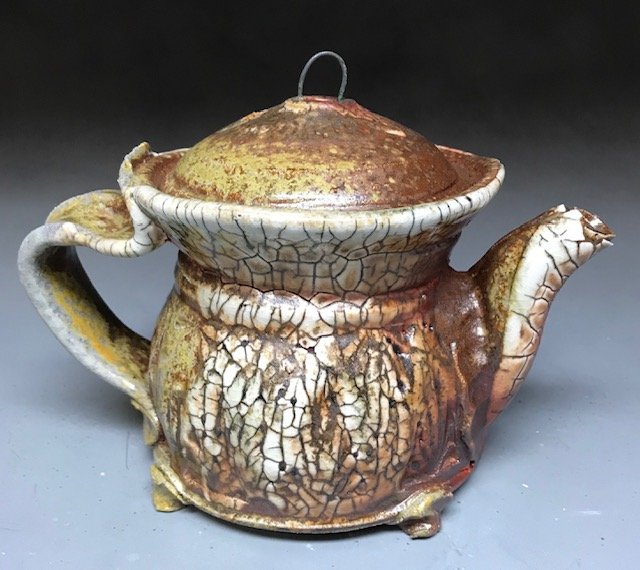
Yes, I just pull them and stick them on. I remember once I was in Wales with Mick Casson. He walked by me and said, “Nice jug on that handle, Tony.” And I said, “Mick, you know, is it too big?” He said, “No, no, no, no, that's your thing. Do it. Do it even bigger.” The funny thing is, Hamish, I think making handles is harder to learn than throwing pots. Good handles make ordinary pots look pretty fantastic.
Hamish
Yeah, it's true. It's really hard to teach people how to make a decent handle.
 Tony
Tony
Yeah, because they don't enjoy it. They'll sit at the wheel for eight hours and listen to music and have a grand old time. But ask them to stand by the table and pull a handle for half an hour, and they’re not so happy.
Hamish
I've just, I'm teaching a class at the moment on teapots, and we're doing handle pulling for the first like half hour of each class.
Tony
Oh, boy.
Hamish
The students are not enjoying it all that much. But I love that Mick Casson anecdote. Have you received other advice over the years that you think about in the studio?
Tony
I had built a chambered kiln with Linda Christianson, and we had our first firing. I’d made these plates with a very casual swoop of white slip on the plate, and we were doing a sort of critique between the two of us. She turned my plate over and said, “Tony, you really like these plates, don't you?” And I said, “Yeah, I do.”
She never said a thing, but I know what she did. She turned it over and looked at the bottom, which had very fast, tight little trimming marks. The outside of the plate was slow and casual, so the bottom didn't relate to the top. She didn't have to say anything. I knew it first. It's trying to get all those parts to sort of relate. Oftentimes now I look at pots, and I say, “Ah, fast wheel.” That's how you would trim wood, right?
Hamish
Yeah, and that was my training, too. Fast wheel, stiff clay. Try and go quick. Production.
Tony
The older you get, the softer you want your clay. I don't like stiff clay.
Hamish
I saw you were recently making some beautiful, big, voluminous jars. Do you find it hard to get the clay out of the bottom when it's really soft?
Tony
Well, those were made in pieces: thrown and coiled and thrown. So that helps. Hard clay is the enemy of casual pots.
Hamish
Yeah, I've been enjoying softer and softer clay. It's a lot more enjoyable. So, do you throw on a kick wheel or treadle wheel?
Tony
I have a treadle wheel and a Soldner wheel. I can't throw anything very big on the treadle wheel. I use the treadle wheel for cups and bowls, but I don't think I could throw a teapot on it. I like my soldner, but when I throw on it, I do use a very slow wheel speed.
To get casual, you have to go slow. Maybe there's somebody out there who can do it fast, I don't know.
Hamish
It seems from your pots like you're having fun when you're making them. How much do you experiment and play in the studio?
Tony
I hope I'm trying new things. I still change things, but they're nuances. They're little changes. Like the handle on the mug you've got. I pitched the handle. That just started maybe two years ago.
Hamish
Yeah, that's really good.
Tony
That's just a small nuance. It's not huge by any means; it's a little change, but I hope I keep doing that. We probably needed a couple of lifetimes to explore everything that we could.
Hamish
Do you regularly experiment with forms? If you've got a kiln firing coming up, do you think, “Oh, I’ll make teacups and saucers this time; I haven’t made them in years.”
 Tony
Tony
I always start a firing cycle by making cups. I always love making cups. I’m always disappointed when I hear potters say, “Oh, I got to make cups.” I love making them. I've often said, if you make a cup that somebody enjoys, you've really put your business card in their hand. Every day!
I have over 100 cups here in my house. I decided to put them in rotation because some of them weren't getting used. Once I decided on the rotation, I picked out four or five that I couldn't do without. They couldn't go in rotation. They're my go-tos. It's funny: you can have 100 cups, and they're all good; they’re all nice cups, but four or five of them just tug at your heart.
I have probably twenty or more pieces of Ron Myers, and they're not the colorful ones. They're all low-fire, salt, or wood-fired. I don't have his painterly pots. I was thinking, I gotta tell Hamish about this. I don't know why. I'm just more attracted to his forms than the decoration.
Hamish
When I interviewed him, he was drinking out of a wood-fired cup with shino on it. Very, very nice. I think when he's making pots with the intention of decorating, it makes more sense to have a more consistent surface.
Tony
Absolutely yeah. I'm glad you were able to pull an interview off with him. I went down there for twenty years, and every year I'd say, “I’ve got enough of Ron’s pots,” and then I’d get down there and say, “No, I don't.”
Hamish
I certainly don't have enough [laughs].
Tony
I know everybody whose pot is in my house. I think the pots we own in our homes are part of a love affair with the potter, too.
Hamish
Do you find that you've learned things from using other people's pots?
Tony
Oh, totally. All my very best students have a collection of pots that aren't theirs, like you do. And extensive libraries. Sometimes your well gets shallow, and you don’t know what to make for the next firing. If that happens to me, I look across the room and see a Richard Batterham jar. I think, man, that's a nice jar, maybe tomorrow I'll make jars. I think we have to surround ourselves with other people's works, not ours. I don't have any of my work in the house, really.
Hamish
I find I quite like having some of my pots around, because I learn from them. Often it's what I don't like about them.
Tony
Yeah, I mean, it's not that I don't like my pots, but I would rather be in the company of other people when I'm having my morning coffee or whatever.
Hamish
What about functionality and comfort? How much do you think about in relation to the squish?
Tony
I hope I'm thinking about it. Making them with an undulated rim came from listening to Pete Pinnell's “Thoughts on Cups.”
Hamish
Ah, I love that lecture.
Tony
I do, too. He's sitting in a chair reading a book, he finishes his cup of tea, and says, “I never even looked at the cup. Make cups that make people look at the cup.” So with those undulating rims, you have to figure out where you're going to put your mouth. If you don't figure that out, you're going to pour it all down your shirt.
My cousins run this restaurant, which is my former uncle's pottery, and they use some of my cups in the restaurant. People come in and say, “Can we have the ugly cups?” Mine are the ugly cups. I'm not insulted by that. I think it's great that I make the ugly cups.
Hamish
That's fantastic. I was wondering about teaching. I know you have taught a lot over the years. Do you have any particular assignments that you've really enjoyed giving students?

Tony
My former wife used to teach at a college, and at the end of the semester, she would bring her students to our place for a potluck. One of the things they enjoyed most of all was that they would bring some of their pots. They would blindfold me, and I would do a blind critique for them. It's not about the pretty color. It gets back to the importance of tactility and weight. Sometimes they would hand me one of my wife's pots, and I'd say, “Oh, come on, don’t try that; I’ve handled a thousand of these.” A black hole critique is a really interesting thing to do.
Hamish
That’s a great idea. I totally appreciate that, but the surface is also important for the look and feel of the pot. When you are thinking about the surfaces, what have you gravitated towards over the years? Do you mix it up?
Tony
I yeah, I do. Sometimes you go back, and you look at things that you made ten years ago, or whatever, and think, man, I'm getting worse. That was a good series of pots I did ten years ago, and I should do that again.
Hamish
I just saw that you were making some pots that have more color and decoration.
Tony
I’m getting into color right now. I don't know what's going on. I'm not sure how I feel about it, because when I look around my house, I don't have pots like that. I should be making pots that I would want in my own house.
Hamish
Is it fun to play, though?
Tony
Absolutely. A friend of mine who was also a huge giant whose shoulders I stood on was Robin Hopper. At the end of Robin's career and life, he decided he wasn't going to do workshops anymore, so he gave me his quiver of brushes.
He said, “I won't be using them anymore, Tony; you use them.” And I said, “Robin, if I put a mark on a pot with a brush, it's going to ruin it.” And he said, “Go home, get some newspaper and some red iron oxide and make 10,000 marks. They're gonna be ugly, but they'll get better.” And so now I'm enjoying it. I really am enjoying mark-making with a brush. I hope they get better. I need to make another 10,000 marks. But I am enjoying it.
Hamish
I'm a little scared of color and brushes too.
Tony
Look at your shirt. You shouldn't be. For the longest time, I was an advocate of quiet pots. Linda Christianson’s pots are perfect examples of quiet pots, understated pots.
Hamish
Yeah, that is what I was getting at. That sort of subtle surface can help with the feeling of softness and modesty and warmth, I think.
Tony
I went to the Mingei Museum in Japan, and I was blown away by those pots. They were so fantastic and quiet. And I'm not doing that, but then I guess I'm not quiet. I've been called gregarious. I talk to everybody, and I'm sort of loud, hopefully in a nice manner.
Hamish
That reminds me that I want to plug your blog, in case people don't know about it. It is very entertaining.
Tony
Well, it's really more of a Facebook thing right now. Apparently, I need a new computer. My computer won't handle my blog anymore. I don't know what's gone wrong, but I haven't been able to put a picture up on my blog since August. I started the blog in 2007 when I went to Jingdezhen with John Neely. It was a way to keep in touch with my kids and my family.
Everything in China is so bloody interesting that I was getting 750 to 1,000 readers a day. You'd go to Walmart and see sharks hanging from the ceiling. Then I just continued. This is where I see a similarity in your trajectory because the interviews and the writing help you think. You're doing this because you're thinking. And when I write, I really don't write for you; I write for me. It's helping me get through this thought process. My oldest high school buddy said, Tony, when you're not writing or not making pots, I’m worried about you. It's what we do.
Hamish
Yeah, I totally relate to that. Did you journal when you were young?
Tony
No, no. I think my blog has been my diary. For the last eighteen years.
Hamish
That's what I've enjoyed about Instagram. I use it as a diary, really.
Tony
It was John Neely who put me onto Instagram. He said, “Tony, why aren't you on Instagram?” And I said, “I don't know anything about that.” He said, “Well, it's visual, and you need to be on it.” It's good. We have to put ourselves out there. I mean, some people think of it as shameless self-promotion, but you’ve got to make a living.
Hamish
Well, I think I've asked all my questions. Is there anything that you wish I’d asked or that you’d said?
 Tony
Tony
Geez, I don't know. I don't know if I've got anything brilliant to say. I’m just grateful for the community. The arts community is the most accepting community. And I'm lucky, lucky, lucky to hang out with some amazing makers from all over, I really am. I’m grateful.
Hamish
My last question is a bit tangential! I’m wondering if you had to pick just one vegetable to eat for the rest of your life, what would it be?
Tony
Bacon.
Hamish
Haha, alright. How do you like to prepare this vegetable?
Tony
I like it fried crispy and as an addition to many of my favourite dishes.
Hamish
Well, thank you. I really appreciate you talking with me today.
Tony
Thank you! Cheers.
