

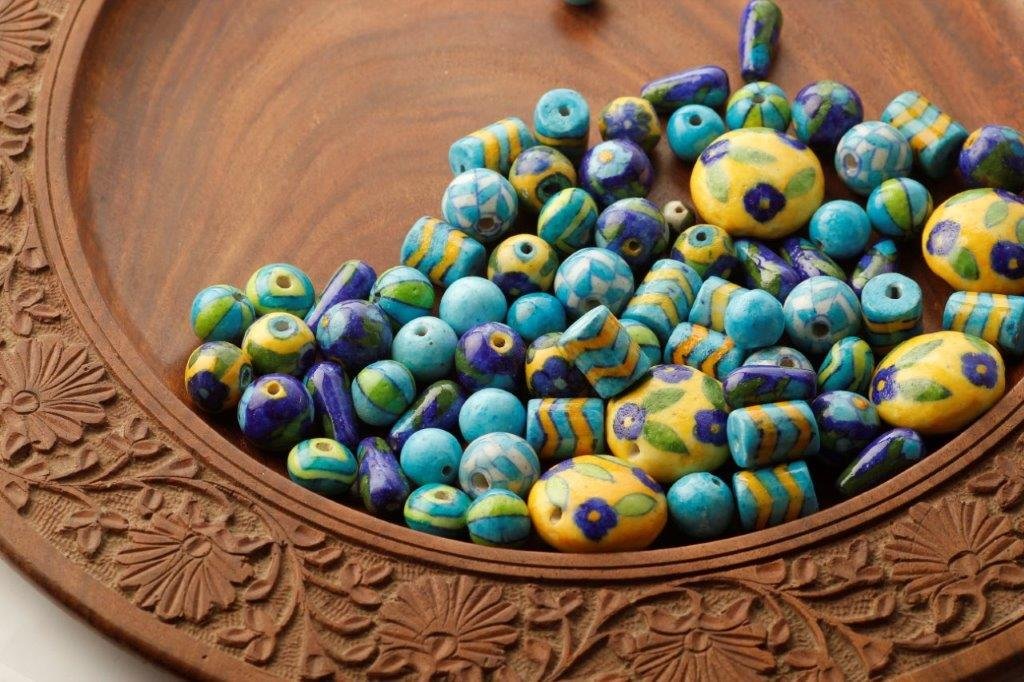
 The city of Jaipur, India, has a long tradition of making a specific style of blue-glazed pottery. It is known as “Jaipur blue pottery,” and has earned a geographical indication certificate as a traditional craft of Jaipur. It traces its roots to Turko-Persian culture (beginning in the ninth and tenth centuries), pervasive in the regions that are present-day Iran, Uzbekistan, Turkmenistan, Tajikistan, Afghanistan, and minor parts of Kyrgyzstan and Kazakhstan. Although Jaipur has been the prominent center, other areas where this style of pottery is practiced include the villages of Neota and Kotjewar near Jaipur and in the communities of Kumhar, Muslim, Natt, Rajput, and Regar.
In this article, I’ll discuss the traditional understanding of Jaipur blue pottery and the roles of women in this craft. By describing the historical development of this pottery tradition, and the women who have made contributions to it, I hope to provide a context for understanding the contemporary changes that women are bringing to this pottery technique. I’ll conclude by highlighting the work of two female artists, Chetna Arora and myself, who have chosen to use the traditional craft techniques of Jaipur blue pottery as a medium of self-expression.
History
Blue pottery of Jaipur was initially produced in the form of tiles for covering the domes of mosques and royal tombs of kings in Jaipur. The craft was in decline until the nineteenth century, when it was revived briefly under the reign of Maharaja Sawai Ram Singh (1835–1880). Yet even during its revival, production techniques remained closely guarded secrets, and it is largely believed that because they were not popularized, the original blue pottery techniques were lost.
During the post-Independence era of the 1950s and beyond, the pottery tradition was again revived, with success this time, by two women. The social reformer and freedom fighter Ms.Kamaladevi Chattopadhyay assigned the task of researching and developing this pottery technique to a prominent artist, Mr. Kripal Singh Shekhawat. Princess Gayatri Devi of the Jaipur royal family, who was a pioneer of women’s education, founded the Maharani Gayatri Devi (MGD) girls’ school in Jaipur in 1943. MGD girls’ school was the first educational institute to support the teaching of the Jaipur pottery techniques by creating a proper pottery studio with a kiln.